

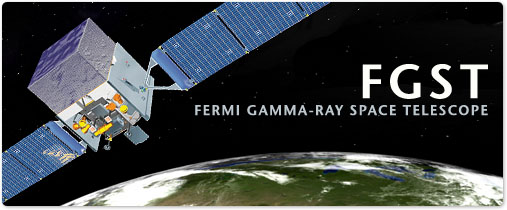

The newest major space observatory, the Fermi Gamma-ray Space Telescope (FGST, formerly GLAST), is working to unveil the mysteries of the high-energy universe. Launched into orbit on June 11, FGST studies the most energetic particles of light, observing physical processes far beyond the capabilities of earthbound laboratories. FGST's main instrument, the Large Area Telescope (LAT), operates more like a particle detector than a conventional telescope. From within its 1.8-meter cube housing, the LAT uses 880,000 silicon strips to detect high-energy gamma rays with unprecedented resolution and sensitivity, filling in gaps in understanding left by previous missions, and pushing new boundaries in particle physics and astrophysics. The SLAC National Accelerator Laboratory, a U.S. Department of Energy (DOE) laboratory operated by Stanford University, managed the development of the LAT and integrated the instrument from hardware fabricated at laboratories around the world. SLAC also runs the Instrument Science Operations Center (ISOC), which processes the LAT data.  read more »

More News & Press Releases » 

NASA’s FGST mission is an astrophysics and particle physics partnership, developed in collaboration with the U.S. Department of Energy, along with important contributions from academic institutions and partners in France, Germany, Italy, Japan, Sweden, and the United States. |
